
Personal
Testimonials| Media
Testimonials(see
below)
HOT BIKE Tech Review
December 2003
Click
here to read the latest!
SCOOTER
RIDER MAGAZINE Product Review Fall 2003
Click here
to read the latest!
Motorcycle
Tour & Cruiser
Product Review
By Laura Brengelman
Bike Barn
Wandering around the annual Powersports trade
show in Indianapolis this year, I saw a lot of
great products. But I didn't find all that much
that I'd call truly innovative. That is until
I turned a corner and saw my first Bike Barn.
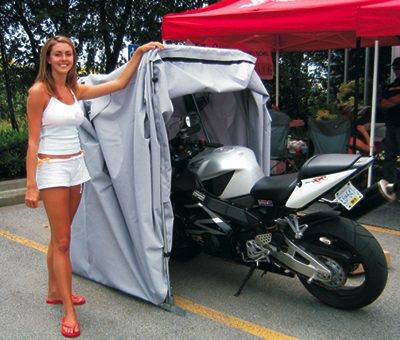
In some ways, a Bike Barn is similar to a temporary
tent erected for a special event. Its metal skeleton
is made of round, galvanized steel poles, which
insert into each other. The poles run through
sleeves in the sturdy, synthetic canvas cover,
which also attaches with Velcro. Treated for water
resistance, the cover has two vents.
The ingenious difference is that the ends of the
U-shaped supports bolt to a central area in the
rectangular base on either side. From there, they
rotate up, opening the shelter like an old-fashioned,
roll-top desk and revealing the perfect-sized
storage enclosure for a motorcycle.
Bike Barns come in three sizes: a Sport model
($279, plus shipping and handling) suitable for
small sport and dirt bikes, a Standard size ($349)
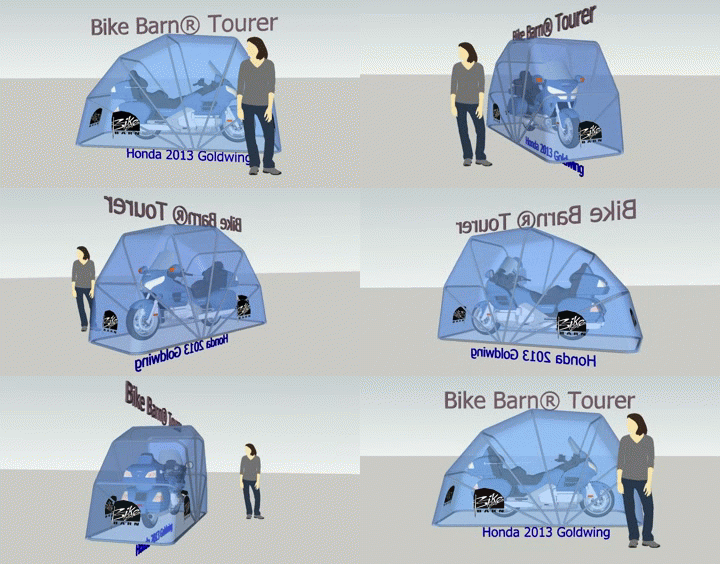
that will fit most cruisers, and a Tourer that's
big enough for a full-sized dresser. Billed as
a Y?non-contact motorcycle enclosure,? the beauty
of it is that you pull your bike in, park it,
and close the Bike Barn over it. And nothing comes
in contact with your bike's paint, plastic,
or chrome.
Since my BMW has a tall windshield and Givi back
case (and I bring home various test bikes), I
ordered the larger Tourer Bike Barn model. Given
a choice, I would have asked for a green cover
(to blend into the shrubbery), but this size only
comes in a rich burgundy.
I'd like to be able to tell you that the eight
pages of directions and diagrams provided were
flawless and that I put my Bike Barn together
in under an hour. In fact, I struggled determinedly
in my driveway for a good, long time, until my
husband arrived home and came to my rescue. This
is a job for two people.
My dad taught me to unpack a kit carefully and
check the packing slip to ensure that all the
parts are there (A). The Bike Barn Hardware Description
List clearly showed a selection of 20 bolts and
four rubber feet. After counting my bounty, I
came up with only 16 bolts and no feet (B).
Off I went in search of a metric ruler to determine
what was what and what was missing, also grabbing
our box of metric hardware to see if we had the
right-sized spares. After all this, I discovered
that some kind soul in British Columbia had simply
saved me a step, using the four 'missing' bolts
to attach the four 'missing' rubber feet to the
base pieces. (The directions have since been revised
to include this change.)
According to the diagram, I first laid out the
sturdier, back part of the base frame and the
two side pieces. Next, I tried to figure out which
upright mounted in which hole. It took me awhile
to figure this out, and later measuring revealed
that the diagrams are not proportionate. (Happily,
the company now stamps numbers on the bigger parts.)
Working from the back, the trick is to connect
the shortest support in the first hole, then the
longer support with the extra hole, and then two
plain, long supports. On the second plain support,
reverse the bolt, don't use a plastic washer
on the outside, and leave it loose for the time
being. In the last hole, bolt on the sides of
the front frame with the two rubber feet towards
the ground.
Each bolt (with the exception of the one you reversed)
gets two plastic washers (on either side of the
hole in the base pole) and a locknut (at the other
side of the upright pole). I started by fitting
the pieces together by hand (C). To tighten each
bolt, I used 13mm sockets on a 3/8" ratchet, along
with a crescent wrench (D). When my husband came
along, I was less than halfway done. He showed
me the neat trick of using a battery-operated
drill, fitted with a 3/8" socket driver (E).
After all the uprights are attached (F), use a
10mm socket to attach the short support pieces
(the ones with holes at both ends) from the extra
holes in the side of the base to the holes in
the second upright. Next, put the cover in position;
'The Bike Barn' logo goes in the front. Use the
large Velcro strip at the back bottom edge of
the cover to secure it to the base.
Working your way up to the front, insert each
of the straight crosspieces in the sleeves inside
the tent. (This is where that second pair of hands
comes in handy.) Use a mallet or hammer to attach
each end of the crosspiece to an elbow, and connect
each elbow to the corresponding upright. Note
that the elbows have an oval and a round end and
will only fit one way. Be careful not to catch
the fabric cover in the joints.
When the structure is complete, use the small
Velcro strips inside to secure the rest of the
bottom edges. On the outside, fasten the grommet
at each side of the cover to the fourth bottom
bolt (the one you inserted in reverse) and tighten
it down.
While a Bike Barn isn't as secure as storing your
bike indoors, it does provide protection from
straying eyes - passersby are less likely to peek
inside this pseudo-shed than under a fitted cover.
For added security, locking hardware and a plate
for securing the frame to the ground is provided.
And once this thing's locked up, it wouldn't be
easy to get a motorcycle out unobtrusively.
Most of all, I like it for the convenience. For
someone who rides every day, getting a bike into
our shed is a major production involving crossing
the yard, negotiating uneven flagstones, unlocking
the arsenal, and lowering a heavy ramp. Now, I
just ride up to the top of the driveway, open
my Bike Barn, and put the bike away. And it's
right where I want it the next morning. I think
these Canadians are onto a good thing. (MT&C)
This article to appear in the October 2000 issue.
All text copyright Motorcycle Tour & Cruiser.
HOT BIKE Product Review
January 2001
Click here
to read the latest!
The BikeBarn by P.T.I. Products: For those riders
that do not have a closed garage to keep their
bikes in, this is a great solution.
It is a semi-permanent structure. There are three
(3) sizes available so that you don't have to
buy more than you need. The smallest is called
the Y?Sport Model? and the size is 92? long, 38?
wide and 53? tall and comes only in the color
gray for $299.00. The Y?Standard Model? is 108?
long x 42? wide and 67? Tall and comes in black
for $369.00. The Y?Tourer Model? comes in burgundy
color as in the photo and is 136? long x 54? wide
and 75? tall which is plenty of room for my GL1500
with the tall Tulsa windshield. All prices include
shipping. You will find the Canadian prices on
their website.
The
assembly of BikeBarn is rather straight
forward, but should you need help, you can call
collect for additional help from a real person.
I went to their website for pictures of what it
should look like without the cover on and that
really helped me out. The only complaint I had
was that the galvanized steel tube ends that slide
into each other still had burrs on them. A file
took care of this problem. The tubing is completely
rust resistant and rigid. The material is a high
quality Nylon fabric that is 100% polyester with
a urethane coating, which makes it 100% waterproof
material. The poles run through sleeves in the
cover, which also attaches with Velcro.
The
BikeBarn has a vent on each side towards
the top and located near where the windshield
is located. An anchor Plate is provided to secure
the structure and it can even be bolted permanently
if desired. It is even lockable when closed. There
is a base plate for your front wheel to sit on.
It only took one extra try to put it in the proper
place when using the center stand. When open,
the cover does not collapse completely but is
open about 2/3rds so that when you stop, you are
not under the cover making it easy to get on and
off your bike. It is not heavy, so it is easy
to open or close.
I
received mine during the winter and had the opportunity
to test it in heavy snow conditions. It did not
leak but I imagine that if you left the wet snow
on it long enough it could stretch the material.
In light snows, I just ignored it. I haven't
anchored mine yet, but it is recommended that
you do to protect it from the wind, although I
have not had any problems with the wind.
As
I plan on permanently storing it on dirt, I intend
to buy a sheet of ?? exterior plywood to attach
it to. As you can see in the photo, you do not
ride over any of the tubing when riding your bike
in or out of it. I found it large enough to store
my garden tractor with the front snow blower attached
to it and still able to completely close it.
Contact
them by calling (604) 521-6444, E-mail sales@thebikebarn.net
and check out their website at www.thebikebarn.net.
The BikeBarn has a two-year warranty.
Mark & Carm Hornstein
Gold Wing Touring Association
Touring News Magazine
(719) 495-4079 voice
(253) 663-7184 fax
www.GoldWingProductReviews.com
www.GWTA.org
PRODUCT
REVIEWS ? BIKE BARN
Prying, curious hands and airborne Y?schmutz?
are the bane of motorcyclists everywhere. Park
your Harley outside and it's vulnerable to all
kinds of perils, including rain, snow, hail, sun
fading, aerial assault by our feathered friends
and unauthorized Y?paws?.
Bike Barn to the rescue. Bike Barns are little
portable canvas Y?garages? that come in three
sizes. The Sport model, designed for smaller machines
like Sportsters; the Standard size that we tried
out, which will fit most Harley cruisers comfortably,
and the Tourer that's large enough even for
an Ultra Classic with all the luggage in place.
Bike Barns can be installed on patios, in carports,
or out in the open at home or office. Unlike garden-variety
motorcycle covers, Bike Barn is a Y?non-contact
motorcycle enclosure,? so it won't rub against
your bike's paint, abrading its finish. Just
tilt the front up and it stays in place. Park
your bike insides, step out and pull the cover
down. There's even a small latch setup that
allows a padlock to be installed. The sturdy cover
is waterproofed and has two screened openings
with flaps that provide ventilation.
Bike Barn's upper metal frame is made of galvanized-steel
tubing, which is formed so that it can be assembled
into U-shaped bows. The bows fit into sleeves
in the canvas cover and then bolt to the lower
perimeter frame.
Assembly was fairly easy. With about 20 nuts and
bolts, plus a handful of washers, it took a little
over an hour. There's a metal plate that goes
across the bottom near the front that's designed
to be anchored to the ground or pavement to hold
the Bike Barn down when it's windy (or needed
to keep wanna-be thieves from carrying it away).
Everything that's needed for assembly is included,
except for anchor hardware.
Since we've had the Bike Barn, the wind hasn't
really kicked up. However, the canvas and framework
appear to be quite sturdy. According to PTI, they've
tested a Bike Barn in a wind tunnel at 75mph from
both ends with no damage or adverse effects.
Obviously, the Bike Barn isn't as secure as
storing your Harley in a real garage, but it does
provide protection from the elements. All Bike
Barns come with a two-year warranty and prices
include shipping anywhere in North America. We
found it to be a nicely made product that will
help protect your bike.
Ken Freund
American Rider Magazine
Reviewed
in Motorcycle News - 6th Jan 1999 by Bill Spurdens
"This is a great idea if you haven't got a garage
to park your bike in. You just ride your bike
in and then pull the canopy over the top and lock
it a ring set in the ground. The Bike Barn is
made from rust resistant galvanized steel tubes,
covered with tough nylon. It's 275cm (9ft) long,
160cm (5ft 3in) tall and 106cm (3ft 6in) wide
- easily big enough for most tourers and sports
bikes. There are no problems with condensation
because flaps let the air circulate - keeping
the bike dry. As a result my Suzuki GSX-R750 didn't
show any signs of corrosion, even when it was
parked soaking wet. I've used it for months and
the Bike Barn is showing no signs of wear and
tear. You'd have to drop something heavy and sharp
on the fabric to tear it. But be careful lifting
the cover after rain because you can end up with
water all over your boots! With a ground anchor
fixed inside the cover, your bike would be really
secure. It's worth paying the money to keep your
pride and joy in top condition - and it's cheaper
than building a garage!"
|